Applied Mathematics
University of California, Los Angeles
Research
Nonlinear PDEs model many complex physical systems, but simulating them forward usually needs information that is missing in practice — the full initial state, the model parameters — or a fully resolved solver that is too expensive for the application. My research uses data to build PDE models that can still make forward predictions under those constraints: data assimilation to recover the state from partial observations, inverse methods to recover unknown parameters, and reduced-order models to bring down the cost. The three projects below apply these ideas to convection, to incompressible flow past obstacles, and to a nonlocal model of bacterial growth.
Data assimilation for convection
Many problems in science and engineering call for reconstructing the full state of a flow from partial observations. Continuous data assimilation, or nudging, does this by adding a feedback term to the model. For a system \(du/dt = G(u)\), the assimilating system is
\[\frac{d\tilde{u}}{dt} = G(\tilde{u}) - \mu\, I_h(\tilde{u} - u),\]
where \(I_h\) interpolates onto the observed part of the state and \(\mu\) sets the relaxation rate. When enough is observed and \(\mu\) is chosen well, \(\tilde{u}\) converges to \(u\) — including in the components that are never observed directly.
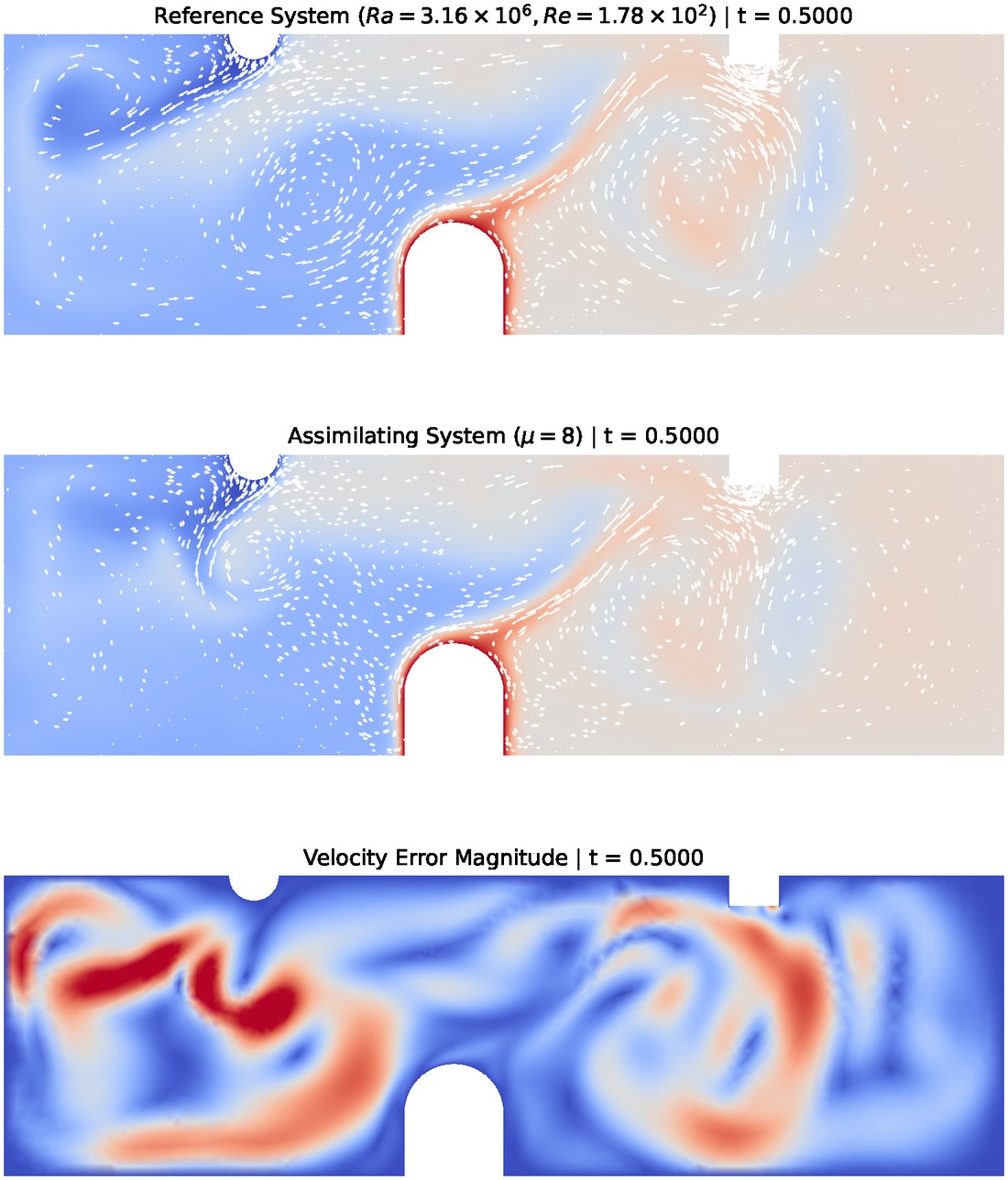
My current work, with collaborators at the Nevada National Security Sites, asks how much of a flow can be recovered when only temperature is observed. The setting is mixed convection in a ventilated room, governed by the Boussinesq equations: cool air enters through an inlet, and a heated object on the floor drives buoyant circulation. Temperature sensors are cheap and can be embedded in walls or equipment, while velocity probes are intrusive, so a temperature-only filter would be practically valuable. In the assimilating system only the temperature is nudged; the velocity is never observed and is recovered entirely through the buoyancy coupling.
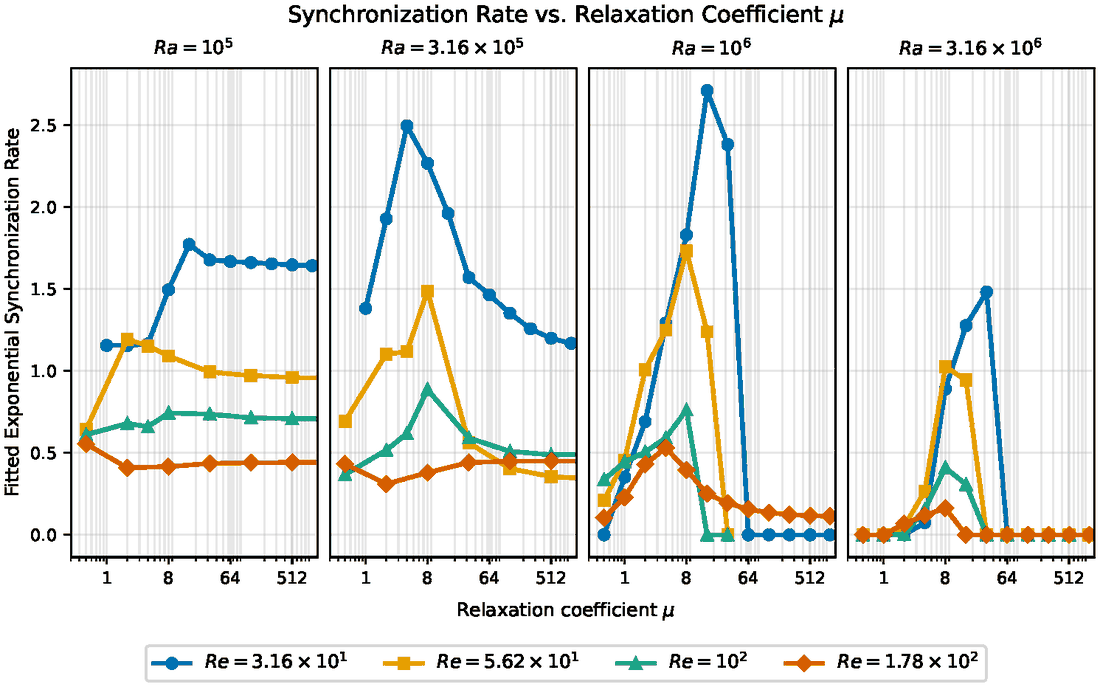
The central finding is that synchronization depends nonmonotonically on \(\mu\). Existing nudging theory guarantees recovery once \(\mu\) is large enough, but across a grid of Rayleigh and Reynolds numbers we find both a lower and an upper threshold, and the window between them narrows as the Rayleigh number grows, closing entirely at \(\mathrm{Ra} = 10^7\). To explain the upper threshold I analyzed a Lorenz ’63 model in which only the temperature-like variable is observed: as \(\mu \to \infty\) the error dynamics collapse onto a linear cocycle whose largest Lyapunov exponent is positive, so synchronization must fail in that limit. In the other direction, I proved a local exponential synchronization theorem that holds on a two-sided window of \(\mu\).
The simulations run on a finite-element solver I wrote in FEniCSx/DOLFINx that advances the reference and assimilating flows in lockstep on unstructured meshes, with MPI-parallel assembly and PETSc multigrid-preconditioned solvers, across 25 combinations of Rayleigh and Reynolds number and relaxation parameters spanning several orders of magnitude.
This project grew out of my master’s thesis on Rayleigh–Bénard convection and the joint work with Vincent Martinez and Jared Whitehead that followed it, published in Inverse Problems. There the question was how to recover unknown parameters alongside the state. We derived two nudging-based parameter-recovery algorithms from first principles — one as a relaxation Newton iteration, the other as a relaxation least-squares scheme — and gave structural conditions under which they converge. On two-dimensional Rayleigh–Bénard convection, both recover the Rayleigh and Prandtl numbers together with the full state from low-mode observations.
Reduced-order models for flow around obstacles
Digital twins of physical assets need forward models that are accurate to within a few percent and cheap enough to run repeatedly, so a fully resolved simulation is frequently neither necessary nor affordable. Reduced-order models built from proper orthogonal decomposition address this by projecting the equations onto a data-driven basis, but they need the state to lie near a low-dimensional subspace, and they generalize poorly to geometries unseen during training.
During a 2024 internship at the Nevada National Security Sites, working with Sean Breckling and collaborators at the Special Technologies Laboratory, I developed a hybrid scheme for Navier–Stokes flow through a domain punctured by circular obstacles. Reduced-order models are deployed only on congruent square subregions surrounding each obstacle, with a full-order model retained everywhere else. Because the subregions are congruent, a single training simulation supplies one useful snapshot per obstacle per time step, and the resulting basis transfers to obstacle configurations that never appeared in the training data. The two regions are coupled through a discontinuous Galerkin domain decomposition with \(H(\mathrm{div})\)-conforming elements, so interface conditions are imposed weakly and mass is conserved across the boundary, and the reduced degrees of freedom are advanced by a least-squares Petrov–Galerkin scheme that minimizes the residual at each step.
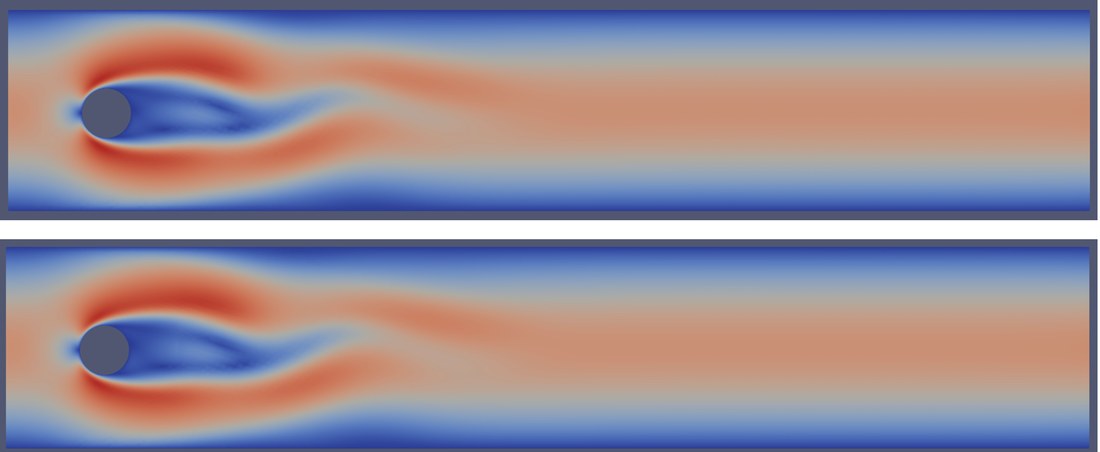
Numerical experiments indicate that the hybrid scheme reproduces full-order flow at reduced cost in both time and memory; a manuscript is in preparation. The collaboration has continued through an NNSS grant to UCLA, which supports the convection project above.
Learning interaction kernels for bacterial colonies
Colonies of Paenibacillus dendritiformis communicate over long distances by releasing a lethal factor that inhibits the growth of neighboring colonies. This produces a striking “stationary fronts” phenomenon in which two nearby colonies arrest each other’s growth. A previously developed model captures this by tracking colony boundaries as evolving planar contours, driven by curvature, a constant growth rate, and nonlocal self- and cross-interaction forces. The interaction kernels behind those forces cannot be derived from first principles, so in joint work with experimentalists at Montana State University’s Center for Biofilm Engineering I posed their recovery as an inverse problem against image sequences of growing colonies. The project began at the 2023 UCLA Computational and Applied Mathematics REU, where I mentored the undergraduates who prototyped the first image-processing and simulation tools.
Two modeling contributions came out of this. I generalized the governing equations to admit a nonlocal transport force acting along the axis between colony centroids — not restricted to the normal direction, as in classical geometric flows — which substantially reduced model error at the cost of two additional parameters. And I introduced a class of “ramp” interaction kernels that outperform the Gaussian kernels proposed in earlier work. Recovering the kernels also meant building the surrounding pipeline: a seeded-region-growing segmentation that extracts smooth contours where false edges and fine “feathering” defeat simple thresholding, a tangent-angle formulation of the contour dynamics that isolates the stiff curvature term so the contours can be advanced pseudospectrally, and a derivative-free optimization over the model parameters, since reparametrization and interpolation inside each time step make the forward solver non-differentiable.
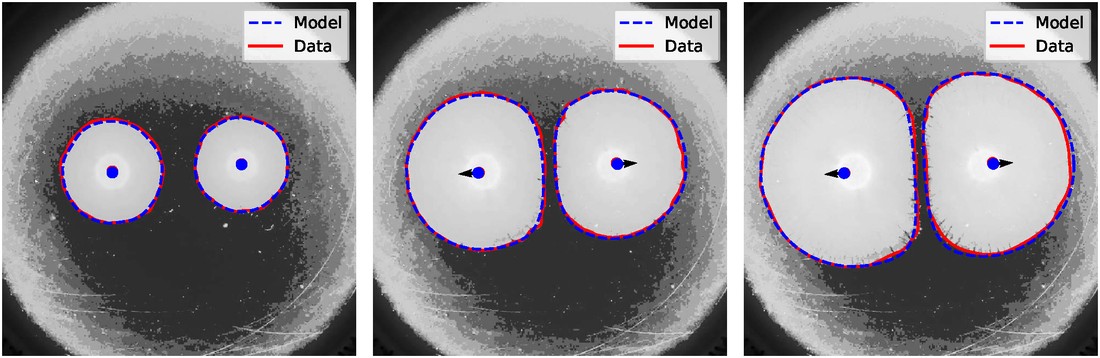
The trained models track experimental colony boundaries with average relative losses of 9–17% on the two-colony datasets and reproduce the stationary fronts phenomenon. A manuscript is in preparation.
Undergraduate research
As an undergraduate at Brigham Young University I worked on three projects, two of which led to journal publications.
Stability of stochastic switched systems
In a switched system the rule governing the dynamics changes over time, and the switching itself can be a source of instability. We gave a simple sufficient criterion for a system with i.i.d. stochastic switching to be stable in expectation, extending earlier results for linear switched systems to the nonlinear case. We also introduced patient stability — stability that survives the introduction of time delays, which are intrinsic to any real system — and gave a criterion for it in the stochastically switched setting. Both criteria sidestep the Lyapunov, linear-matrix-inequality, and semidefinite-programming machinery usually needed for such results.
Gerrymandering in Utah
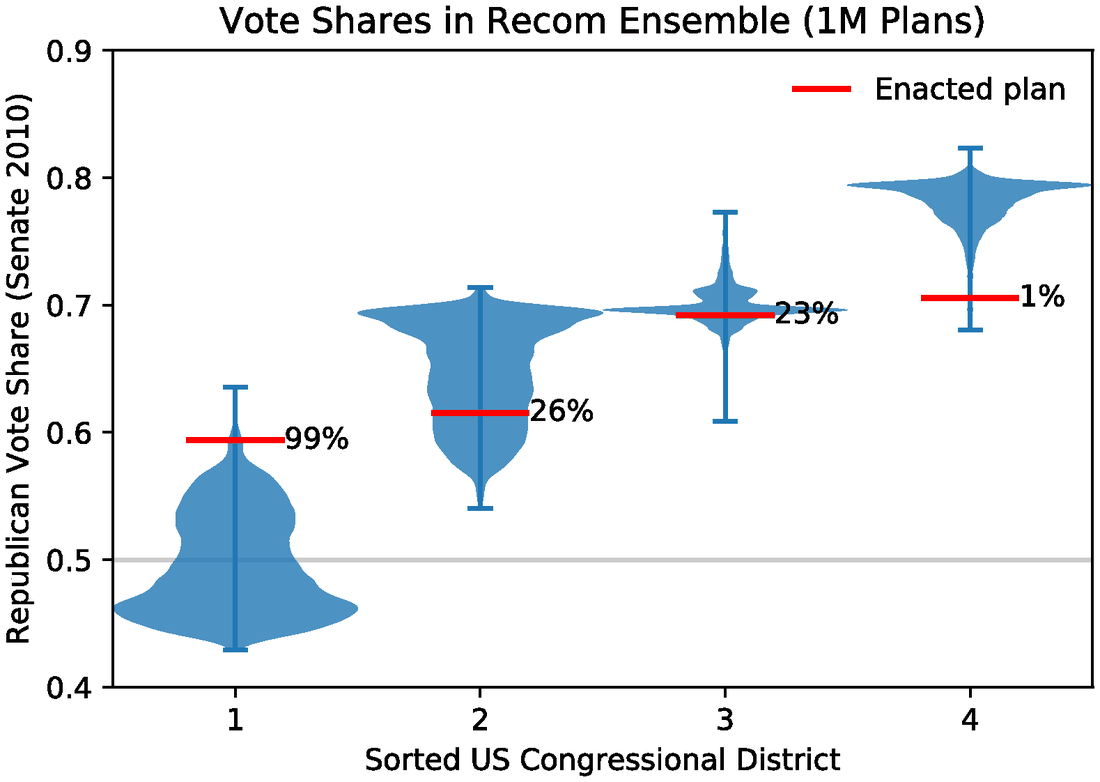
We investigated whether Utah’s 2011 congressional map is a partisan gerrymander by generating large ensembles of alternative districting plans with Markov chain Monte Carlo sampling, then using the ensembles to evaluate the standard measures of partisan fairness in a state with at most one competitive district. In that setting most of the usual metrics are uninformative, so we proposed a new one — the Republican vote share in the least-Republican district — which turns out to be very effective for quantifying gerrymandering there. I built the sampling pipeline and obtained, processed, and cleaned the geographic and election data.
Celestial mechanics
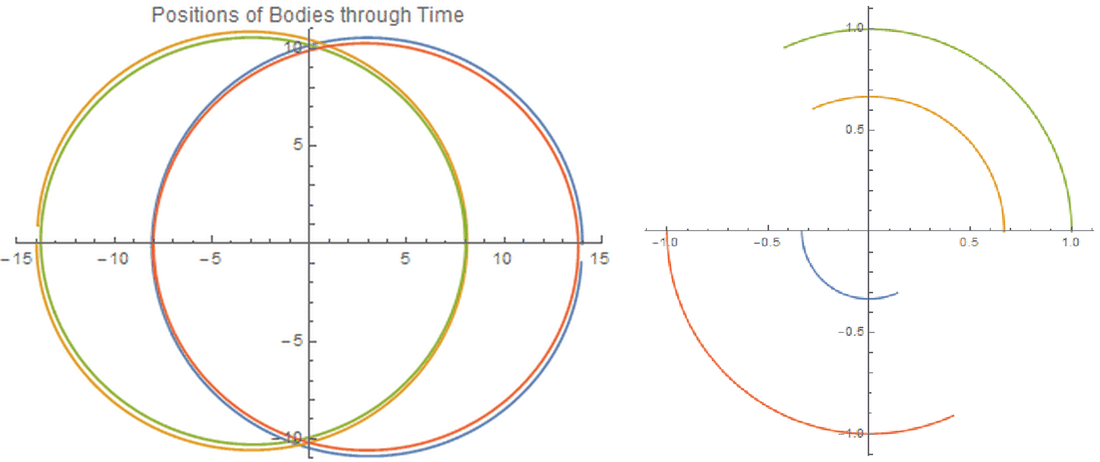
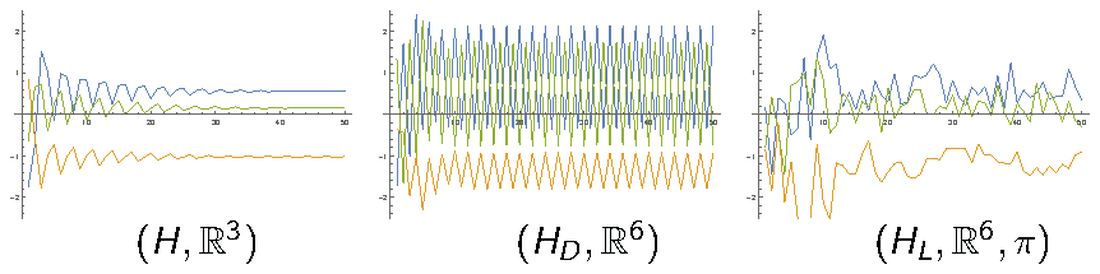
I first used numerical experiments in Mathematica to construct exchange orbits in symmetric \(N\)-body problems — periodic solutions in which two bodies swap orbital characteristics, as Saturn’s moons Janus and Epimetheus do — by layering Kepler orbits with the right symmetry. Returning to the project later, I studied a simplified four-body problem in which two small bodies move in the gravitational field of two primaries on Kepler orbits — a model for a binary asteroid pair that sits between the restricted three-body problem and the full four-body problem. I proved existence and uniqueness of collinear equilibrium orbits in each of the possible orderings of the bodies, and examined their stability through the spectrum of the linearized Hamiltonian system.